Passing Through the World - ALWAYS ON THE WAY
As a child my favorite game was flipping through the family photo album, tracing where my parents had traveled. One shot stopped me every time — a group photo against a backdrop of strange, jagged peaks with the words 'Stone Forest' scrawled across it. Years later this Yunnan trip left a few free days around Kunming, and the Stone Forest Scenic Area, in Shilin Yi Autonomous County, sat barely 90 kilometers from Fuxian Lake — an easy drive, though the sky stayed a flat, unfriendly grey. Plateau weather turns on a coin, so I kept willing the sun to break through. Of course it didn't: the moment we paid and stepped onto the shuttle, the rain came down. By the ticket gate it hadn't eased — it poured harder, and we'd brought no umbrella.
I'd hoped to outwait the rain, but it only fell harder. We had a single half-day here, and the tickets weren't cheap — 400 RMB for two adults and a child, shuttle included. Just as our mood sank, Brother Dong dodged toward a knot of people ten meters off and came back with disposable raincoats at a fair 10 RMB each. We wrestled them on and stepped, laughing, into sightseeing mode.
The Stone Forest Scenic Area holds the world's largest sword-shaped karst landscape, and carries three grand titles: "Essence of World Karst," "The Greatest Wonder Under Heaven," and "Natural Museum of Sculptural Landforms." In 2007 it joined the "South China Karst" inscription on the World Natural Heritage list.
All those titles, and there I was grumbling: "Stone Forest is one of a kind, and I'm seeing it in the rain." Then the thought landed: we're here now, so make the rain part of it. A wet walk makes a better story anyway — and if not, we can always return.
Come to Stone Forest without doing your homework first (the science section below helps) and the bizarre rocks of this "Greatest Wonder Under Heaven" start to blur together. You'll leave feeling that skipping it would've been a shame — and coming was an even bigger one.
The karst field sprawls over 1,100 square kilometers, with 350 square kilometers under protection — a scale hard to picture. Its main arms are the Stone Forest, Naigu Stone Forest, Dadieshui, Changhu, and Guishan National Forest Park. The Stone Forest proper, our start, splits into five: Greater Stone Forest, Lesser Stone Forest, Ten-Thousand-Year Lingzhi, Lizi Garden Hollow, and Bushaoshan.
The Greater Stone Forest crowds its peaks into a stone basin. Sword-shaped columns stand ramrod straight, straining at the sky; the tallest free-standing one tops 40 meters — dizzying to crane at. We lost ourselves in the maze, and when the rain peaked we ducked into a stone hollow where water sheeted down on every side, a karst Water Curtain Cave. The child was thrilled — even the rain had its own magic.
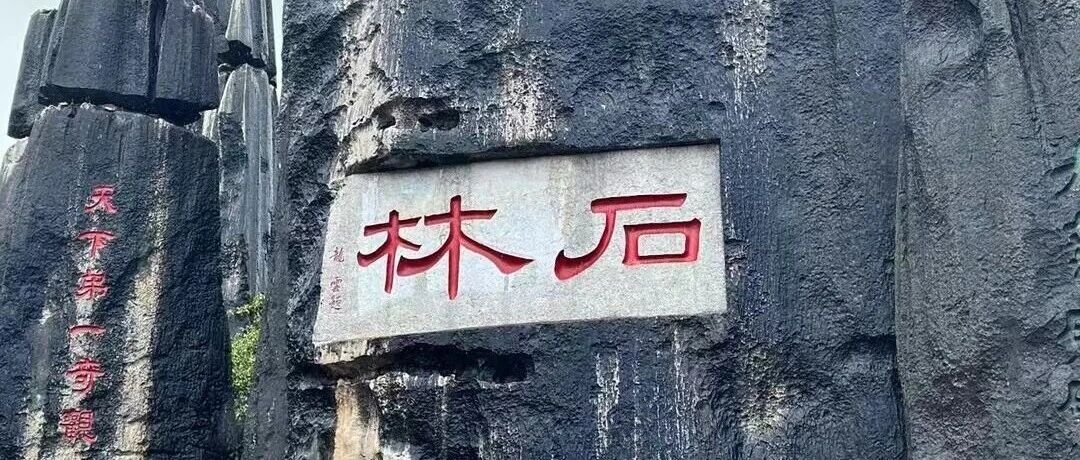
Half an hour in, our shoes were already soaked through. Then the famous "Stone Forest" inscription swung into view. I raised my phone, turned, and found blue sky and white clouds behind us — the heavens had relented. The canopy cleared, sun poured down, and yet raindrops still fell: the strangest, loveliest weather.
We followed the route, weaving up and down through the maze. Facing nature's patient, strange handiwork, I had no words left.
At last we climbed Wangfeng Pavilion for a full 360-degree sweep of the "Stone Forest Sea" — and, worth noting, the best photo perch in the park.
Then on to the Lesser Stone Forest, through gentler country. Where the Greater feels dense, grand, and a little dangerous, the Lesser opens up — more spacious, more refined. Its signature is the "Ashima" stone.
Everyone knows Ashima's story. This tragic love tale is also the emblem of Sani culture, kept alive by the Yi Sani people who've worked this land for generations — a spirit that "bends but never breaks."
After the Lesser Stone Forest the sky dimmed and a thin drizzle returned — and I caught myself glad of it. Regret the trip? Not a bit. The off-season meant thin crowds and a far better walk, so if you want Stone Forest to yourself, skip peak season.
Special Reminder: ticket details are below. Buy one day ahead on platforms like Ctrip for a discount — same-day purchase isn't offered there, and the on-site box office gives none.
About Stone Forest - What You Should Know
The Yunnan Stone Forest records a singular chapter in Earth's geological story. Roughly 270 million years ago this was open sea; through a long, tangled evolution it became the stone relics we walk among now.
Its heritage rests on limestone columns of every shape, scattered wide. So many stand like trees that the place earned the name "Stone Forest." It's famed for tall columns, varied surface karren, and colored underground forms; most rise 10 to 30 meters. Sword, column, cone, tower, and mushroom shapes all show up here.
The forms are complex and ancient, growing alongside other karst pieces — stone teeth, dissolution hills, depressions, lakes, rivers, waterfalls, caves — into a full set of plateau karst types.
Some rock layers brim with bioclastic fragments. The Qixia and Maokou carbonate formations especially hold crinoids, gastropods, and brachiopods. These fossils matter as much to the eye as to science.