Gold is the first thing Bangkok teaches you. Gilded spires stab the tropical haze, temple roofs stack like lit flames, and incense smoke threads through the courtyards of the Grand Palace. Somewhere inside those walls sit the three great Buddha images every traveler comes looking for — one carved from jade, one asleep in gold leaf, one solid gold that hid under plaster for three centuries.
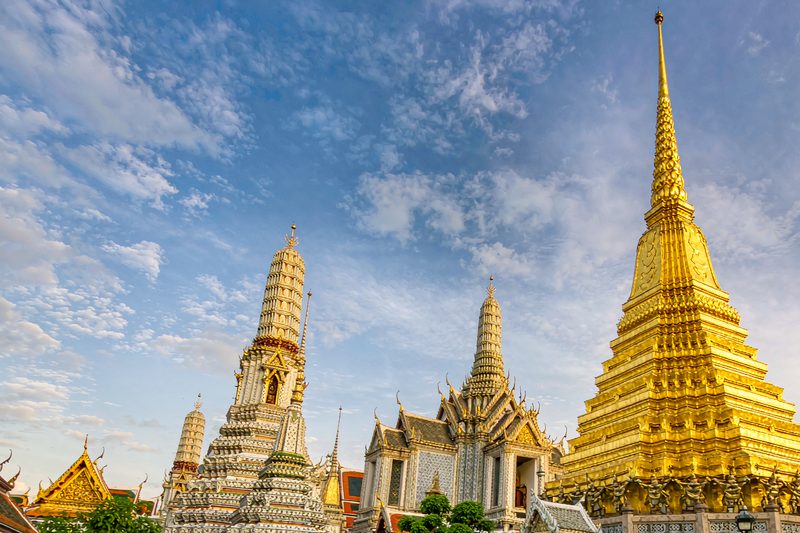
This is a quiet pilgrimage through the sacred heart of the old capital — a day of bare feet, incense, and gold that never quite stops gleaming.
Wat Phra Kaew — the Temple of the Emerald Buddha
Inside the Grand Palace, a royal complex that fills a quarter of the old city's walled heart, stands Wat Phra Kaew — the most sacred ground in the kingdom, founded in 1784 under King Rama I. The image at its center is carved from a single block of jade and is said to hold relics of the Buddha himself; the king had three golden robes made for it, one for each season, and they are still changed with ceremony. Thais call the little green figure their guardian of the nation — kings and prime ministers swear their oaths of office before it.
The image did not always live here. It was once the treasure of Laos, carried to Bangkok after war reshaped the region. Around it, the chapel walls are painted edge to edge with the Jataka tales — the past lives of the Buddha — and scenes from the great Indian epic the Ramayana. The altar beneath the jade Buddha is built of solid gold and set with gems that catch every candle; on a weekday morning the hall is already crowded with kneeling worshippers, and you understand why this is called a national treasure.
Wat Pho — the Temple of the Reclining Buddha
South of the palace walls, Wat Pho guards a Buddha who sleeps. The temple dates to the 14th century, and its great hall holds a reclining image in the posture of the Buddha's final Nirvana — cast in iron, 46 meters from head to toe, 15 meters high, its whole body thickly gilded and inlaid with jewels. You walk its length like a slow processional, past enormous mother-of-pearl feet, and even the quiet feels enormous.
Wat Pho is the head temple of the Mahanikai school of Thai Buddhism, and because so many bronze Buddhas stand in its courtyards it is also known as the "Temple of Ten Thousand Buddhas." Spend an hour among them and you will believe the number.
Wat Traimit — the Temple of the Golden Buddha
Near the old central railway station, Wat Traimit keeps a quieter miracle. A seated Buddha cast in solid gold, two meters tall and weighing 8.5 tons, it was forged in the Sukhothai era. When the Burmese–Siamese wars rolled through, the faithful plastered over the gold and buried it in the earth, where it stayed for more than three hundred years. Dug up, stripped of its grey shell, the metal beneath was warm, heavy, untouched — and it is said no one knows quite how many tons were there until it was weighed.
With the Emerald Buddha and the Reclining Buddha, the Golden Buddha forms Thailand's three national treasures. Between them you have the whole arc of Thai devotion: a king's jade, a temple's sleep, and a refugee that survived war underground.
Beyond the Three
Bangkok's sacred map runs wider than the famous trio. There is the Marble Temple, built almost entirely of white marble; Wat Bowonniwet, headquarters of the Dhammayuttika order; and, best of all, Wat Saket on the Golden Mount — a hill that rises out of the flat city like a green bell. The temple was begun under Rama I, and its golden stupa, about sixty meters high, holds relics of the Buddha. Climb the winding stairway and all of Bangkok falls open below you: spires and gilded roofs flashing in every direction, a city that looks, as one old traveler put it, as if it had fallen straight from the sky.
Travel Tips
Wat Phra Kaew and the Grand Palace: dress modestly — shoulders and knees covered — and arrive early to beat the tour groups. Shoes come off before entering the chapel halls.
Wat Pho: besides the reclining Buddha, the temple grounds are home to the famous Wat Pho Thai Traditional Massage School — a fine way to end a long temple day.
Getting around: the three temples and the Golden Mount sit along the same old riverfront zone; a river ferry or the Skytrain (BTS) stitches them together neatly, and Wat Traimit is a short walk from Hua Lamphong railway station.