Passing Through the World - ALWAYS ON THE WAY
In Wong Kar-wai's "In the Mood for Love," Tony Leung's Chow Mo-wan confesses a quiet belief: that in older times, a person with a secret would climb a mountain, bore a hollow into a tree, and whisper it inside — then seal the cavity with mud, leaving the secret to linger there forever, known to no one. By the film's closing frames, Chow Mo-wan travels to Cambodia and presses his secrets into a hollowed stone at Angkor Wat, sealing them away for good.
And so Angkor Wat lodged itself in my memory. Not long after, I devoured Jiang Xun's "The Beauty of Angkor" in a single sitting and fell under its spell. When I finally set foot in this hushed, mysterious land and drifted among Angkor's moss-slick ruins, the scale and silence of those ancient towers stopped me in my tracks again and again. Reading Jiang Xun first turned out to be a small mercy — without him I'd have shuffled through blindly, the original purpose of my trip dissolving among the broken walls. Detractors call Angkor Wat a disappointment, "just a pile of old stones." But learn the story threaded through these blocks — an empire's rise, its faith, its slow surrender to the jungle — and each stone becomes the echo of a dynasty, a whole vanished civilization.
The Angkor Dynasty
The Angkor Dynasty rose in the 9th century AD and crested under Jayavarman VII in 1181. At its height, its reach swallowed all of present-day Cambodia and spilled into Thailand, Laos, Myanmar, and Vietnam — in effect, most of Southeast Asia.
After invaders left the old capital a smoldering ruin, Jayavarman VII resolved to raise a new one built to withstand any assault — and so Angkor Thom, the Great City, was born. A perfect square girdled by sheer, thick walls, it opens through five lofty gates. At the crossing of its central avenues rises the kingdom's heart: Bayon Temple, keeper of the world-famous "Smile of Angkor."
Yet as taxes and forced labor crushed the people, the king's god-given authority began to fray. Year after year of drought seeped into the foundations of royal power. Then in 1432 the Siamese Ayutthaya Dynasty swept in; the reigning king fled, shifting his capital to Phnom Penh and leaving Angkor to the roots and the rain. From that day the city simply disappeared.
It wasn't until 1860 that the French biologist Henri Mouhot, guided by the pages of "The Customs of Cambodia" (Zhenla Fengtu Ji), found the Angkor ruins where they had lain buried for over four hundred years in the jungles around Siem Reap.
Strictly speaking, "Angkor" names a whole constellation of ancient monuments. What most travelers call "Angkor Wat" is more accurately Angkor Temple — the world's largest temple ruins and the earliest work of Khmer architecture.
In 1992, UNESCO added the Angkor monuments to its World Cultural Heritage list.
The Customs of Cambodia
Had "The Customs of Cambodia" never been written, Angkor might still be sleeping under the canopy. So we owe its author a debt — a tireless traveler, or perhaps a patient "spy" — Zhou Daguan.
Zhou Daguan was a Chinese scholar of the Yuan Dynasty. In 1295 (note: the source text gives 1925, almost certainly a typo for 1295), the Yuan Emperor Chengzong, Temur Khan, sent him to lead an embassy to what is now Cambodia. He remained three years. On his return he placed "The Customs of Cambodia" before the throne — likely first drafted as an official report — a documentary of 13th-century Zhenla: its architecture, daily life, food, dress, marriage rites, religion, politics, and climate, captured frame by frame.
The Zhenla Dynasty thrived across centuries. In 1431 the Siamese brought it down. The court retreated south to Phnom Penh, and Angkor, its old capital, was left to the vines — swallowed by jungle, erased from memory. And yet it was "The Customs of Cambodia" that later pulled Zhenla back into the European imagination. In 1860 the French biologist Henri Mouhot followed that same book to the Angkor ruins, where they had slept beneath the forest for more than four hundred years.
Formation, Duration, Decay, Emptiness
Jiang Xun put it this way: "Angkor is like a sutra, its verses intoned between sunrise and sunset, full moon and new moon, flowers opening and flowers falling, birth and death — waiting for each of us to wake up to it."
Once you have Angkor's story in your bones, the Buddhist idea of "formation, duration, decay, emptiness" (cheng zhu huai kong) starts to make sense. The four kalpas mark the turning of all worldly things: the Formation Kalpa (creation), the Duration Kalpa (existence), the Decay Kalpa (destruction), and the Emptiness Kalpa (void).
Standing on Phnom Bakheng, then moving through Angkor Wat and Angkor Thom, Ta Prohm, Beng Mealea, and Banteay Srei — the Women's Palace — I felt the whole arc of the Angkor Dynasty play out before me: from nothing, to founding, to centuries of life, to the Siamese conquest and the flight to Phnom Penh, and at last four hundred years of stillness beneath a tropical forest. The four kalpas, made flesh.
Angkor Thom, Angkor Wat, Banteay Srei, and Tonle Sap Lake
For all their mystery and spread, the Angkor monuments are thoroughly mapped for visitors. The established routes fall into three loops: the Small Circuit, the Grand Circuit, and the Outer Circuit.
Day 1: South Gate of Angkor Thom - Bayon Temple - Baphuon - Phimeanakas - Elephant Terrace - Angkor Wat - Sunset at Phnom Bakheng
Day 2: Angkor Wat Sunrise - Preah Khan - Pre Rup - Ta Prohm
Day 3: Banteay Srei (Women's Palace) - Beng Mealea - Bakong - Boat Tour of Tonle Sap Lake (sunset viewing possible)
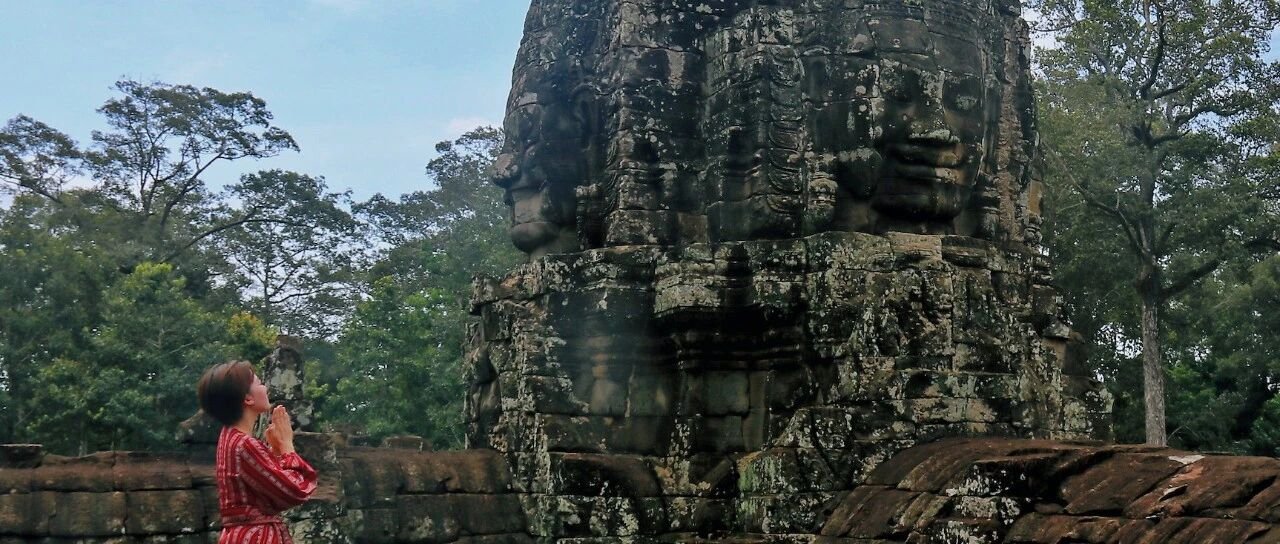
Bayon Temple guards the world-famous "Smile of Angkor" — the soaring mausoleum Jayavarman VII raised for himself. Its five-tiered central tower stands for Mount Meru, the Hindu axis of the world. Step inside and you are ringed by serene Buddha faces on every side. Their carved eyes seem to close in shadow, then open as the light shifts, while the gentle smile never wavers — a calm that settles over you like warm air.
Bayon's outer walls carry some 1,200 meters of bas-relief — 12th-century war between Khmer and Cham, alongside the small dramas of ordinary life. History and art, cut into stone.
Baphuon sits nearest Bayon. Walk the 172-meter causeway and you can almost hear the footfalls of those who trod it eight centuries before. Restoration is now largely finished. The sanctuary rises as a five-tiered pyramid; from afar it reads as a heap of stone crowned by a single doorway — a frame around the infinite. The complex sprawls wide, its steps brutally steep. Wooden stairs have been added, though the very summit stays off-limits.
Ta Prohm — Jayavarman VII built it for his mother, a devout Buddhist, and Hollywood later borrowed it for "Lara Croft: Tomb Raider." Its signature is surrender: the jungle has nearly swallowed the temple whole. Massive trees bolt up from the rooftops, their roots lacing the stone like the coils of huge serpents until wood and temple seem one — uncanny, charged with a quiet force. Standing there, you bow to life's stubborn will: from a single seed splitting the mortar to limbs sprawling across the ruin, these giants pulse with a vitality as worthy of reverence as any Buddha. As the old line goes, "Heaven and Earth breed spirits, and also give rise to living things."
Angkor Wat — the name the world knows best, also called Angkor Temple or Small Angkor — is the most staggering structure in the whole complex, the Angkor Dynasty's crowning work at its zenith. Part temple, part tomb, it was raised by Suryavarman II as his own mausoleum and a shrine to the great god Vishnu.
A moat nearly 200 meters across still brims with water, its surface strewn with floating plastic boards that let visitors step across with ease. The 475-meter causeway eats up half the site; at its far end, three parallel gates open onto the inner wall, and a second causeway climbs toward the tallest tower. The final stairs are brutally steep. Attendants at the base hand out passes to cap the crowd — and women must cover to ankle and wrist or are turned back. We clutched the rails and hauled ourselves up on hands and feet, then sat in a quiet corner letting the wind drag its cool fingers across our faces.
The outer galleries of Angkor Temple wear over 800 meters of relief — scenes from the Indian epics "Ramayana" and "Mahabharata," humanity's first mythological picture books. Give them the slow look they deserve.
Banteay Srei, the Women's Palace — though that was never its true name. When the French first uncovered it, its loveliness stopped them cold. Built entirely of sandstone, it blushes a soft rose in the morning and at dusk. Inside stand goddess figures, which led the French to imagine a palace the king had raised for his concubines — earning it the title "Mona Lisa of the East." In truth, King Rajendravarman gave the site to his guru for his closing years of meditation; the residents were monks. The guru, deeming himself unworthy, offered the temple to Shiva, greatest of the Hindu gods. So Banteay Srei brims with carvings of Shiva and his stories — craftsmanship so fine it steals your breath, tales so rich they pull you in.
Tonle Sap — the largest freshwater lake in Southeast Asia, and the maker of Cambodia's broad plains. In the rainy season, May through October, the Mekong actually runs backward into the lake, flooding it with fish and shrimp. The families of the floating villages have lived on the water for generations: children learn to row almost as they learn to walk, and life unfolds on stilts above the surface — bathing, fishing, playing, selling trinkets, ferrying tourists, never leaving the water's edge.
Walking out of Angkor Thom and Angkor Wat, I kept turning over the glory of a civilization that began more than a thousand years ago. Then Tonle Sap pulled me back to the present — the plain, hardscrabble lives of its people, unchanged for so long that without some rupture they may never change at all.
Present-day Cambodia remains poor, and foreigners — Chinese visitors especially — still get robbed with depressing ease; a Chinese face can read to locals like a wallet on legs. I've heard the old joke about being stripped to your underwear more than once. So despite many trips, I keep my phone in my pocket on the street, sling no shoulder bag, wear no jewelry, and dress down — the only way I've found to feel safe.
Safety worries aside, the travelers keep coming — because Angkor earns its billing as a place to see once in a lifetime. Beauty outlasts every change. And when the light lands on Bayon's smiling stone, you may find this enchanted ground has already slipped inside your heart.